
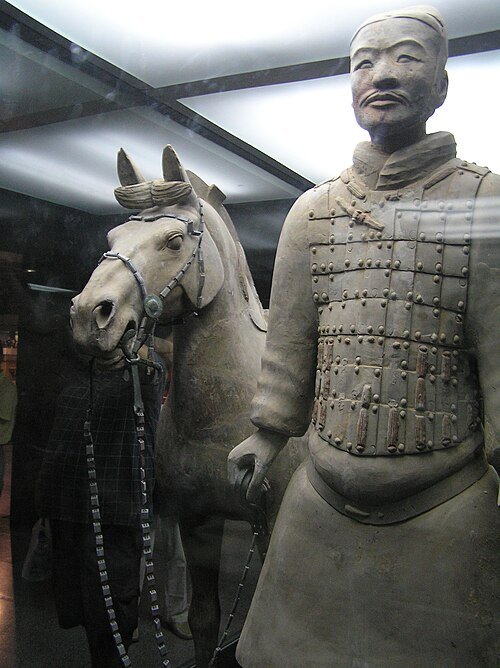

The Terracotta Army is a collection of terracotta sculptures depicting the armies of Qin Shi Huang, the first emperor of China. It is a form of funerary art buried with the emperor in 210–209 BCE with the purpose of protecting him in his afterlife.
The Terracotta Army is a large-scale archaeological and governance artifact—engineered to project imperial authority beyond life itself. Commissioned by China’s first emperor, it represents early-state thinking executed with industrial precision, long before modern production systems were formalized.
| Attribute | Details |
|---|---|
| Location | Lintong District, Xi’an, Shaanxi, China |
| Constructed | c. 210–209 BCE |
| Commissioned By | Qin Shi Huang, First Emperor of China |
| Discovery | 1974 (local farmers) |
| Estimated Figures | 8,000+ soldiers, horses, and chariots |
| Materials | Terracotta (fired clay) |
| Original Purpose | Imperial afterlife protection |
| Current Function | Museum & archaeological site |
| UNESCO Status | World Heritage Site (1987) |
Thousands of life-sized clay soldiers buried with the first Emperor of China to protect him in the afterlife.




 No products in the cart.
Aurora –
The Terracotta Army in Xi’an, China, is a collection of thousands of life-sized clay soldiers buried with Emperor Qin Shi Huang.
It is famous for its detailed craftsmanship and historical significance.